When artist and curator Leon Lapa Pereira was conducting research on termites at V2_ Lab for Unstable Media in Rotterdam a few years ago, everything suddenly fell into place. He noticed how innovatively and sophisticatedly termites build their tunnel systems, collecting sand, soil, and saliva from various sources to reinforce the tunnels. He also saw how they work with air currents when building the tunnels and constructing storage areas. Lapa Pereira shifted his gaze to his fellow human beings and realised how much the behaviour of termites resembles that of humans: we, too, collect our building materials (metals, chemicals) from various places and quickly construct living spaces and transport routes from the ground up. We too build cities taking into account different air currents, for example, to transport sounds and smells through the city. Why, he wondered, don’t we call that nature? Why is nature always something different from us humans? And can you extend that thought: if we are indeed nature, then is what we create – such as robots and spaceships – also part of nature?
Central to Lapa Pereira’s work is what he calls “the deromanticisation of nature”. He explains: ‘The rise of Romanticism in the 18th and 19th centuries created an unbridgeable gap in Western thinking between us and what we have come to call ‘nature’. In that respect, we are unique. If you study the philosophy behind yoga as practised in India, for example, one thing becomes clear: we are our environment. We are part of it. So the question is how it has become possible for us to think of humans as separate from nature. Many Western philosophers are also concerned with this question, including Timothy Morton, Donna Haraway, Merlin Sheldrake, and, of course, Bruno Latour.’
Lapa Pereira has been working with the Embassy of the North Sea for a number of years now. First, during the F/EEL project, and now with the Confluence of European Water Bodies, a network of representatives of European water bodies. For the third edition of the Confluence (21–24 September 2025), all members of the water network – from the Spree in Berlin to the Mar Menor in Spain and the Snæfellsjökull in Iceland – confluenced in Amsterdam and Bergen. As part of the Confluence, Lapa Pereira curated the exhibition The Diplomatic Suitcase at Mediamatic in Amsterdam and accompanied the members of the network during a private workshop day on 22 September in Bergen aan Zee. He reflects on these events on the basis of five questions.
Together with Jakob Kukula, you curated the exhibition The Diplomatic Suitcase, which is currently on display at Mediamatic in Amsterdam (until 21 October). What was the idea behind this exhibition?
‘To answer that question, I first need to explain a little more about the idea behind the Confluence of European Water Bodies. The Confluence is a network that shares, sustains itself, and continues to expand. As I mentioned earlier, in the West we suffer from what I call ‘philosophical headwinds’. When it comes to rights for nature, we lag far behind countries such as Bolivia, Chile, and Colombia. In more and more places around the world, the earth is being enshrined in the constitution of the country. The Confluence was born from this idea: it empowers both the individual and the individual water body, as well as the entire collective of water bodies involved. In a world where the legal framework differs from country to country, this network helps individual water bodies to “grow”, but the exchange and mutual learning about the approach to different water bodies also enhances the movement at an international and European level.’
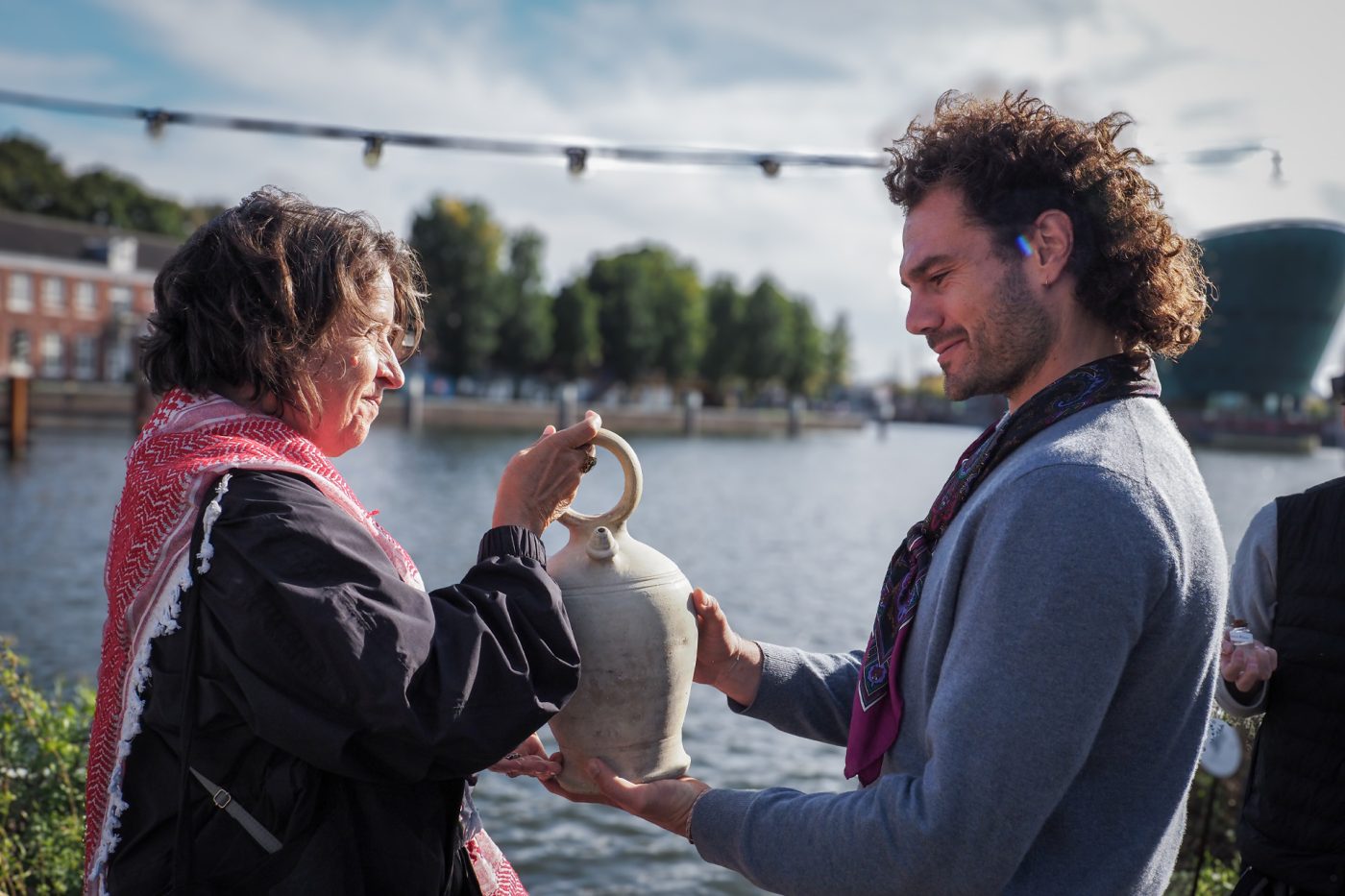
‘The Diplomatic Suitcase was created to reinforce joint negotiations. It is a travelling exhibition that can be activated anywhere in the world to tell the story of individual bodies of water and the relationship between them. The waters are represented by artefacts, or talking pieces, in a large suitcase – including the bones of a seahorse from the Mar Menor in the 1970s and algae from the Venice lagoon. These artefacts tell a story about values and open up a space for negotiation. The water is represented by an object, but is also literally present in a small bottle. There are now about thirty-five waters that are represented. There is also a video projection about the network and an accreditation table where you can sit down and answer four questions about your own personal relationship with water. You can choose to share these in the exhibition or take them home with you. If you wish, you can also add your own information about the waters to the collection. This exhibition touches on questions that I, as a creator, am also concerned with: how can we truly listen to and interact with the waters without imposing our own anthropomorphic values on them?’
Do you have a favourite artefact in the exhibition?
I would like to mention the blue bikini of the Polish River Sisters as an example. They are an (eco-)feminist collective from Poland that protects the rivers in Poland – including the Vistula – and is also very effective in doing so at a political level. For example, they recently stopped the renovation of a dam. The bikini works so well because this object normally represents the sexualisation of the female body. This group appropriates that symbolism by using this object as a tool to make water attractive. Moreover, the bikini makes the idea tangible that we are all water. The idea that humans and water merge into one another. The bikini is a recognisable artefact that everyone can relate to: after all, quite a few people have one hanging in their wardrobe. As a result, visitors immediately make associations and create a story when they see the bikini bottoms. Creativity arises instantly. I think that’s wonderful to see.’
The exhibition contains both a warning and a hopeful vision of the future, according to the accompanying text. Can you explain that further?
‘I think the warning hardly needs any explanation: it concerns human neglect of our waters, the fact that we use them as we see fit, for example, as places to discharge industrial waste. We observe this phenomenon occurring worldwide. The Delta del Llobregat southwest of Barcelona, for example, is heavily polluted, but there are also numerous examples closer to home. Take Dogger Bank, which seems to be gradually turning into one large industrial estate. Most bodies of water tell a difficult story. And all this is taking place in a highly individualised world, in which we are left to our own devices and a sense of community is no longer a given.’
But there is also another side to the story: ultimately, the Diplomatic Suitcase tells a story of collective strength and hope. Take, for example, the community around the Mar Menor in Spain. The strength of this group, which consists mainly of women between the ages of 55 and 75, is hugely inspiring. They have seen firsthand how the Mar Menor has gone from being a beautiful, biodiverse lagoon to becoming heavily polluted and degraded. This has unleashed a great deal of energy. The community around the Mar Menor campaigned tirelessly and collected more than 635,000 signatures. And now the Mar Menor has become a legal entity. If you had asked people beforehand, they would probably have said: That’s impossible. But this group did not give up and drew up a plan. As a group, they were stronger than any individual could have been.’
You also curated the private Monday programme of the Confluence, September 22 in Bergen aan Zee. What was planned for that day?
‘The first day of the Confluence was indeed only for members of the network, because we believe that we must first go inward before we can go outward. After the ceremonial opening at De Balie on Sunday, this day was dedicated to reconnecting and asking how we are doing and what values we want to promote. We started the day with meditations. We then split up into smaller groups to exchange ideas and build a sense of community. The next day, we went outside to Museum Kranenburgh, where we engaged in future thinking with a broader group of stakeholders.’
What moment during the Confluence 2025 has stuck with you the most?
The most special moment for me this year was the moment that we collectively listened to the North Sea for the first time. We weren’t seeing her yet, but the wind was carrying her towards us. It was a sunny morning after a late arrival in Bergen aan Zee, when we practiced a silent walk towards the beach. It is a ten-minute walk through the dunes, and after the first three minutes of silence and our collective auditory receptors sharpening, it suddenly flooded all of us. The stormy breaking of the waves brought anticipation, curiosity, but also worries. Nevertheless, I noticed how people minimally accelerated their steps to finally reach the beach and meet the North Sea that was calling for us to come. Once at the beach, we could let the inner child out, play, sing, and celebrate our reunion.