Article by Katarina Rakušček
“One way to stop seeing trees, or river, or hills, only as ‘natural resources,’ is to class them as fellow beings—as kinfolk. I guess I’m trying to subjectify the universe, because look where objectifying it has gotten us. To subjectify is not necessarily to co-opt, colonize, exploit.
Rather it may involve a great reach outward of the mind and imagination.” – Ursula LeGuin, quoted in Robert Macfarlane’s Is a River Alive (2025)
“Hope is the thing with rivers.” – Robert Macfarlane, after Emily Dickinson
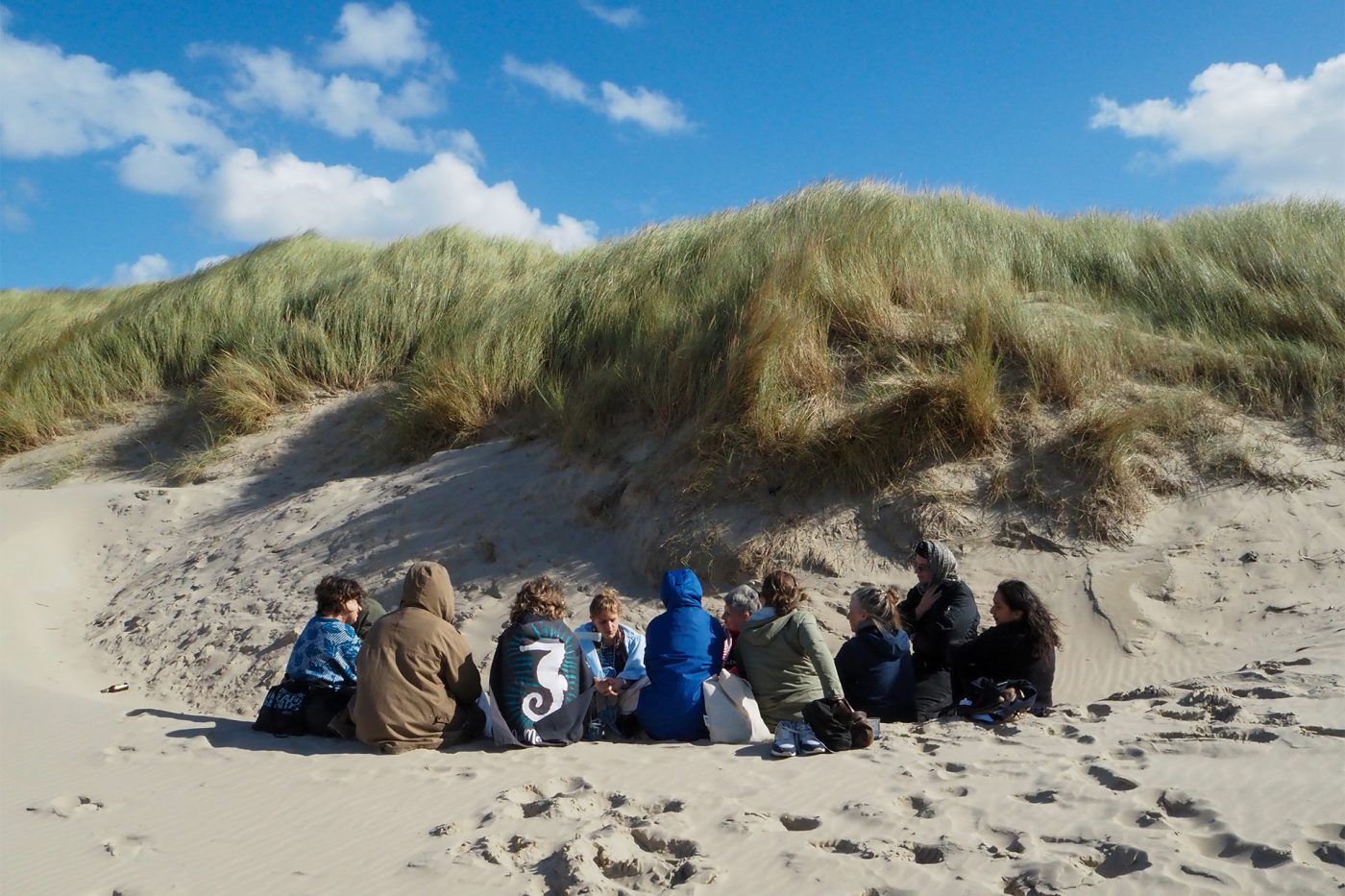
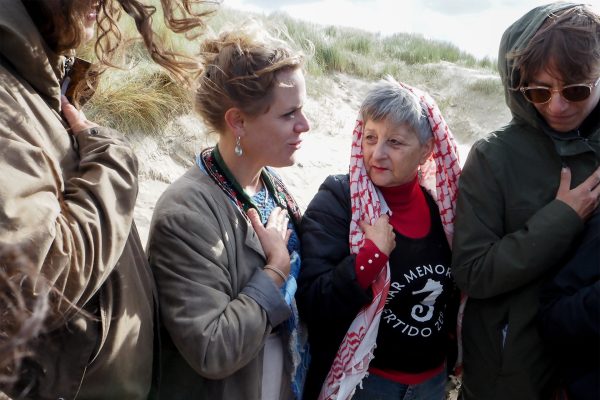
On a bright, windy September day, a group of wandering waterbodies huddle together on the shore of the North Sea. They’ve come from all over Europe and beyond: the Oslo fjord, Mar Menor, the rivers Liffey, Tagliamento, Pek, Zenne, Spree. They have come to this place to confluence⸺to talk about the political representation of water. A common language: the rights of nature.
A free river, a standing forest
To understand why these human beings were referred to with their watery names, we need to sit through a small slice of legal history. The rights of nature framework is a legal theory in environmental law and a global movement that pursues legal personhood for natural entities. Rather than treating nature as property under the law, the rights of nature movement acknowledges that “Nature in all its life forms has the right to exist, persist, maintain, and regenerate its vital cycles,”[1] building upon an intersectional foundation of Indigenous knowledge systems, deep ecology, and contemporary environmental law. One of the first and most prominent breakthroughs of this concept in Western legal thought was articulated in 1971 by the lawyer Christopher Stone in the seminal collection of essays “Should Trees Have Standing?”, in which he argued that “natural objects, such as trees”, should be granted legal rights by appointing ‘guardians’ who are designated to protect the ‘voiceless’ elements in nature[2] . Stone argued that we already grant legal personhood to companies, even those responsible for the devastation of ecosystems–why not the so-called ‘natural objects’?[3] A current example: in the present day, BlackRock⸺an investment company responsible for the deforestation of large portions of the Amazon forest, among many other social and environmental misdeeds⸺is granted legal rights, while the Amazon⸺its direct victim⸺has no legal standing for representatives to argue for the forest’s survival. Questions of legitimacy and ethics are more-than-valid but legally slippery, so legal personhood would provide the forest (or at least its human proxies) with concrete tools to fight against ecocidal practices.
While these ideas were new to the common law, Indigenous scholars Jacinta Ruru and James Morris encountered in this critique of the modern legal system something that was known to them and their community for centuries: they found alignment with the Māori legal concept of a personified natural world[4], recognizing the potential of Stone’s ideas to help bridge the gap between the common law and Māori legal orders[5]. In 2014, the forest Te Urewera in New Zealand was granted legal personhood. The Whanganui River followed in 2017.[6]
Ecuador was the first country to codify the rights of nature in its constitution[7]. In 2008, an amendment was introduced to recognize the rights of nature in light of the need to better protect and respect Pachamama, a term originating from the Indigenous peoples of the Andes that encompasses nature with all her physical and spiritual properties. Since then, Bolivia, New Zealand, Uganda, Nepal, Spain, and others have honored rights of nature in national laws, and countless others, including the United States, India, France, Mexico, Brazil, the UK, and Belgium, have made strides in recognizing the intrinsic value of nature with local ordinances and court decisions.
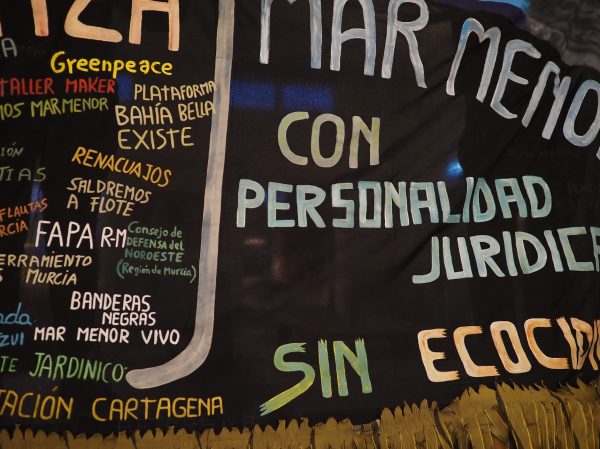
Mar Menor, a saltwater coastal lagoon in the western Mediterranean, was the first ecosystem in Europe to be granted legal standing in 2022[8]., after a historic grassroots campaign led by Teresa Vicente, a professor of Philosophy of Law, who has received the Goldman Environmental Prize (often referred to as the ‘Green Nobel’) in 2024 for this achievement. This severely degraded ecosystem, which effectively collapsed in 2016, is now undergoing an extensive restoration framework. The work is by no means done, but now ignoring the health of Mar Menor means breaking the law and invoking the wrath of half a million signatories of this public legislation initiative. The Mar Menor is now officially a Spanish (and European!) citizen, which means it can also act and be represented under foreign jurisdictions, recently gaining access to courts and acts in Switzerland and Germany.
These steps represent perhaps localized but significant strides for Earth jurisprudence. However, progress should not be taken for granted: at the present moment in 2025, Ecuador is again at a critical point. A government increase in fuel prices catalyzed a wide mobilization led by the Indigenous communities that are most affected and are now facing violent and repressive policies as the state criminalizes their right to demonstration. The rights of nature, the rights of all living, could be under threat in the very country that codified them first.
“Increasingly, the death that occupies each human’s imagination is not his own, but that of the entire life cycle of the planet earth, to which each of us is as but a cell to a body.”
–Cristopher Stone, “Should Trees Have Standing?” (1972)
A language of animacy
The implications of such a recognition for our perception, our laws, and our imagination are manifold. Legal personhood is a concrete tool to challenge profit-based development projects that pay no thought to the literal life-sustaining properties of the ecosystems we live in, and even less thought to the long-term implications of unchecked extractivist practices.
It’s also a challenge to imagination. The rights of nature are a concept deeply rooted in Indigenous knowledge systems and could be criticized as a clumsy transposition into the dry skeleton of the Western legal system. In many ways, it is. It makes evident the gawkiness of Western thought to accommodate a language of animacy[9] without slipping into either legalistic or vaguely esoteric territory. But the concept of the “rights of nature” is neither restrictive nor new-age; it can be a nimble and timely tool pursuing a long-term strategy of dismantling the exploitative practices of late-stage capitalism, while at the same time cultivating a kinder and more just political imagination. In this sense, the rights of nature framework is in unbreakable kinship with other emancipatory movements and practices: decolonial, feminist, anti-capitalist, and advocating for the safety and sovereignty of all living beings. What Indigenous communities and local ecological knowledge holders (as well as scientists, at least since Earth system science) have known for centuries, legislation is still learning: the nature-culture divide is a delusion that gave us some great Romantic paintings at best, and a false sense of superiority that manifested in the worst humanity has to offer⸺the capitalist colonial extractivist project with all its violent, racist, genocidal, and ecocidal endeavors. So, to the objection of those who say, “this means prioritizing river rights over human rights,” the rights of nature respond: you are the river⸺and it means it.
Hydrological governance: a glacier for president, an embassy for the North Sea
The huddled waterbodies from the very beginning of this text know something about a language of animacy. From September 21–24, 2025, the Confluence of European Water bodies took place in the Netherlands, hosted by the Embassy of the North Sea. This initiative was founded in 2023 by three founding partners: the Embassy, TBA21, and ILP Mar Menor, on the historic occasion of the Mar Menor having been granted legal personhood, and focuses on pursuing political representation for water bodies and other ecosystems through strategies such as the rights of nature. The third Confluence to date, taking place in Bergen am Zee and Amsterdam, Netherlands, brought together more than 60 representatives of over 30 water bodies all across Europe.
It is no wonder that the rights of nature movement saw its most significant strides through water–it is an excellent ambassador of aliveness. In the language of hydrological governance, we are all water bodies: Mar Menor, Odra, Ljubljanica, the North Sea, you, me. And how we speak about things does matter, as “a good grammar of animacy can still re-enchant existence”[10], as per writer Robert Macfarlane, author of the book Is a River Alive? and a keynote speaker at this year’s Confluence. In his work, Macfarlane reflects on these shifts in perception, legislation, and language: “to call a river alive is not to personify a river, but instead further to deepen and widen the category of ‘life’ and in so doing – ‘enlarge the imagined range of self to move in’”[11], referencing George Eliot in true Cambridge professor fashion. “It’s an attempt to imagine water otherwise.”[12]
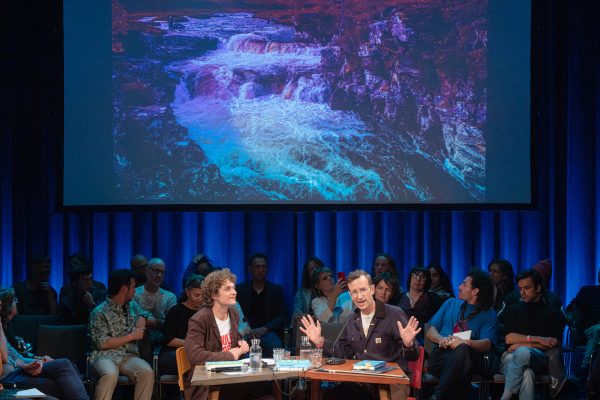
In close proximity to the spirited North Sea, the Confluence of European Water Bodies brought together human representatives dedicated to imagining water otherwise. The Spanish activists of ILP Mar Menor (Teresa Conesa, Julia Albadelejo, Estefania Sanchez-Guerrero, and Carmen Lopez Riquelme) shared their battle with force and passion that could mobilize an uprising. The Icelandic initiative Snæfellsjökul fyrir forseta (Glacier for president) works in the service of the Snæfellsjökul glacier, suggesting non-human governance of their home country. The Odra Person Foundation has just submitted its bill to the Polish parliament. Representatives of the sea, including Emma Critchley, Mekhala Dave, and Antje Scharenberg, call attention to deep-sea mining, as well as Europe’s barbaric border policies, rendering the Mediterranean Sea the deadliest sea on the planet. Li An Phoa advocates for making rivers drinkable again, Klaas Kuitenbrouwer pursues multispecies governance through the Zoöp, the Diplomatic Suitcase is assembled by Leon Lapa Pereira and Jakob Kukula to collect the many stories of the issues European waters are facing and call attention to the importance of water diplomacy. A new, transnational alliance is launched for the protection of the Dogger Bank. Representatives of Spree, Liffey, Tagliamento, Don, Maas, Wattenmeer, Zenne, Pek, and many others are mobilizing in various ways to bring both the conversation and the action on the topic to light.
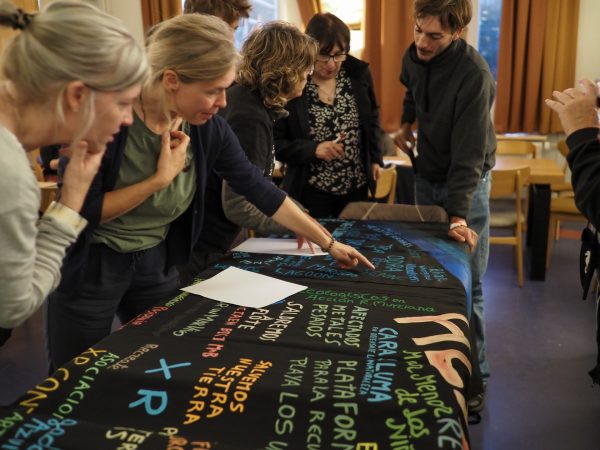
At this point, you might be thinking: is this not a bunch of ventriloquists, human proxies[13] pretending to speak for nature, more eccentric than ecocentric? How can we really know what the river wants? If that is the case, the ventriloquism seems to be working, even though an imperfect tool. The Confluence is an ever-growing, open network of diverse practitioners, including civil organizers, rigorous academics, artistic inquirers, linguists, and legal experts, taking the question of life seriously and fighting to protect it with whatever tools available. ‘I am the river, the river is me’ is a phrase the Māori people of Whanganui use to declare their kinship with their body of water. There is nothing metaphorical about it.
From rivers to seas (and everything in between)
“A river is a gathering that seeks the sea”, offers Robert Macfarlane. In between is where life happens. Except⸺when it doesn’t.
“From the river to the sea”, a call for the freedom and self-determination of the Palestinian people amidst an ongoing genocide, is heard at a ritual of the Diplomatic Suitcase in Amsterdam. The Global Sumud Flotilla, a civilian maritime initiative carrying humanitarian aid to Gaza, is on the way across the waterbody as the Confluence is taking place, and will soon be subjected to violation of several international laws, including UNCLOS, the law of the sea, designed to govern both territorial waters and areas beyond national jurisdiction. The list of broken articles can be quoted extensively. Yet, the activists carrying humanitarian aid to starved and brutalized people will have been abducted in international waters and subjected to dehumanizing conditions. Does it matter, then, whether Odra is granted legal personhood⸺an alleged tool that will grant her survival⸺if thousands of people in occupied territories, along with activists supporting their struggle for sovereignty, are denied their fundamental rights?
The rights of nature movement is not alone in answering, yes, it does matter. Personhood matters as legal as much as a spiritual, cultural, cerebral, and experiential concept. Life matters, and any “grammar of animacy” that helps us cultivate its broader and deeper understanding matters.
This is what it means to be a river, a stream, a sea, an aquifer, a water body. It is to understand that spiritual kinship, collective action, and legislative prowess are tactics in the same pursuit, while building the tools and the imagination to dismantle the system itself. It is to allow our terrestrial minds to be enchanted by the possibilities of waterthought, and at the same time, to know and stand firmly in the material conditions of your surroundings, to pay attention to who is most vulnerable and how those are treated. To be a river is to pay attention to power and imagine it otherwise.
This text was originally published on TBA21’s Ocean-Archive.org in October 2025.
Footnotes
[1] Global Alliance for the Rights of Nature (GARN), an international network of organizations and individuals committed to the adoption of RoN princpiples on a global scale.
[2] Johnson, Paul: Warrior Law Profile: Christopher Stone (2002).
[3] Of course, “natural objects” are neither “natural” nor “objects”, but hold on until 2003 for Donna Haraway, (and others) for naturecultures and other linguistic experiments in articulating our mutual entanglements, and for Ursula LeGuin (and others) to subjectify them.
[4 ] Macfarlane, Robert: Is A River Alive? (2025), p. 25–26
[5] Johnson, Paul: Warrior Law Profile: Christopher Stone (2002).
[6] Ibid.
[7] See more about the Ecuadorian constitution HERE.
[8] More on the case of Mar Menor HERE.
[9] A language, or a ‘grammar of animacy’ is a concept articulated by Robin Wall Kimmerer to help cultivate kinship and ecological compassion.
[10] Macfarlane, Robert: Is A River Alive? (2025), p. 22
[11] Macfarlane, Robert: Is A River Alive? (2025), p. 82.
[12] Macfarlane, Robert: Is A River Alive? (2025), p.15
[13] Macfarlane, Robert: Is A River Alive? (2025), p.83